

About the "tree rings" that grow in our mouth...
- Jun 14, 2021
- 2 min read

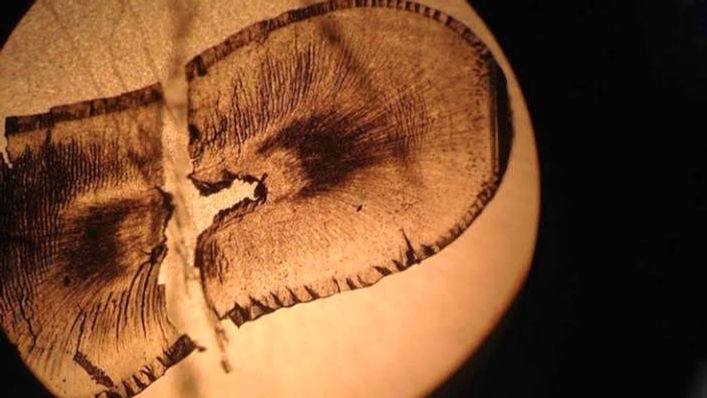
Image of the cementum and its "rings" (Thin section: 80 microns visualized in transmitted light microscopy)
Every Ph.D. student has to face "the Question": so, what's your research about? and fret over finding the clearest, smartest, and most concise way of explaining in layman's terms an incredibly big, complex, and (most of the time) obscure subject. After all, it is a Ph.D. project and it is meant to be original (which really means obscure and confused/confusing!). Nonetheless, some students - myself included - feel the pressure to answer that question in one line (or two, tops!), desperately trying to escape the puzzled expression and the awkward silence that would inevitably follow a summary of theories, counter theories, dead ends, potentialities, and how we wanna save the world in brief (!!). Being a Ph.D. student is not easy, as you are an "expert in training", but really still a student at the end of the day.
So, when it comes to me and my research, to answer the most asked question, I just say that I count our own biological "tree rings". The questions that follow this statement are usually already more interested and more specific, so they are a bit easier to approach.
For example:
Where do you cout these rings from? Our teeth!
How do you do that? Well, I just slice the roots that grow in our jaws in teeny tiny sections and see the rings under a microscope
Wow! And why do you do that? See, the total of those rings will tell me how old a person is and their colour will tell me in which season they were formed. And this is very precious information in forensic anthropology because it is normally not easy to say that by looking at skeletons.
Ta-da! Done.
Easy peasy!
And this is really what I am doing. The appearance of these rings in anthropological terms is called Tooth Cementum Annulation (or TCA, friends only), because they grow for the rest of our life on the thinnest tissue of our teeth, the cementum. The rings have been used for decades now to estimate age and season at death of animals and people. Why am I still studying them? The truth is that we still don't know how this specific 'clock' works exactly. What is its biology, why it seems to follow or be affected by warmer and colder seasons, and so on (here is when the topic becomes more obscure and confused!).
Hence me, squeezing my brain cells out for the next 3 years!
Teeth are marvellous things that keep a record of our life in so many different ways and I can't wait to tell you more about them! For now, though, I thought that an introduction to my research was in order, a sort of follow-up to my personal "about".
I hope you found that as interesting as I do!
Be sure that I will talk about this a million times more, but in the meantime if you have questions or want to know more about it, let me know in the box below!
Also, follow my Instagram account for more pictures!
Thank you for reading!
Comments